
Exoplanet Hunter — Latest Results
🪐 Exoplanet Hunter — Latest Results
Generated automatically on 2026-03-19 07:52 UTC using real NASA Kepler data.
These results were produced by running our Exoplanet Hunter script against live data from NASA’s Kepler archive.
Full Light Curve
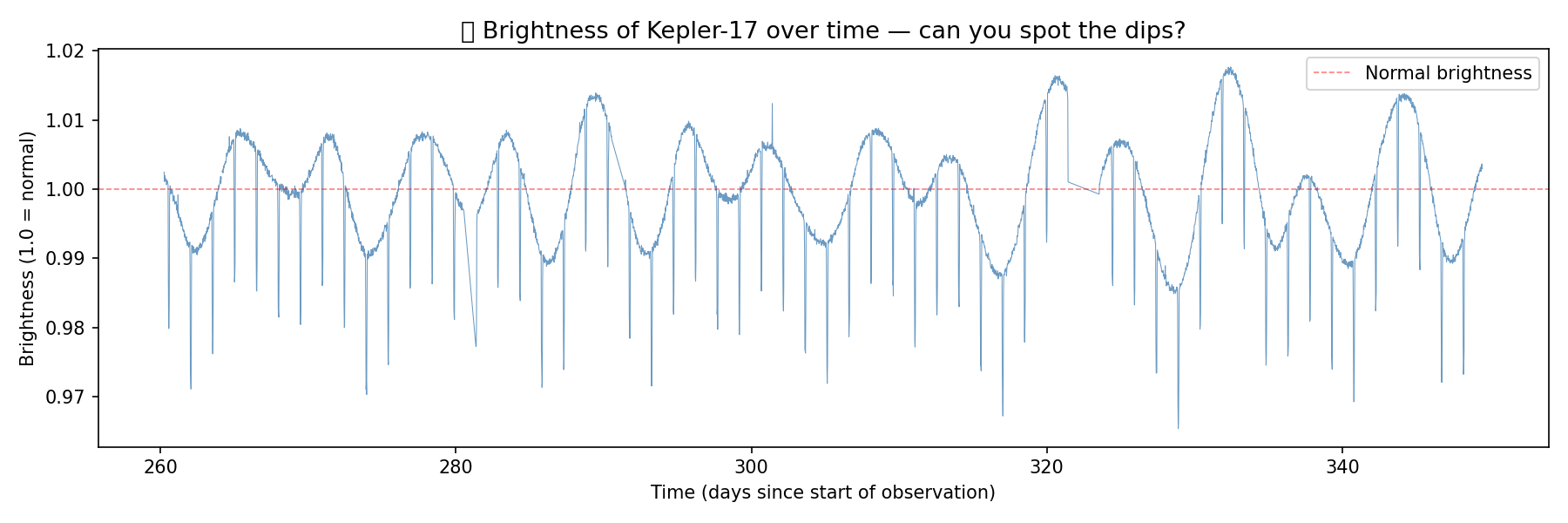
The full brightness record of star Kepler-17 over ~90 days. Look for the regular dips — each one is a planet passing in front of the star.
Phase-Folded Transit
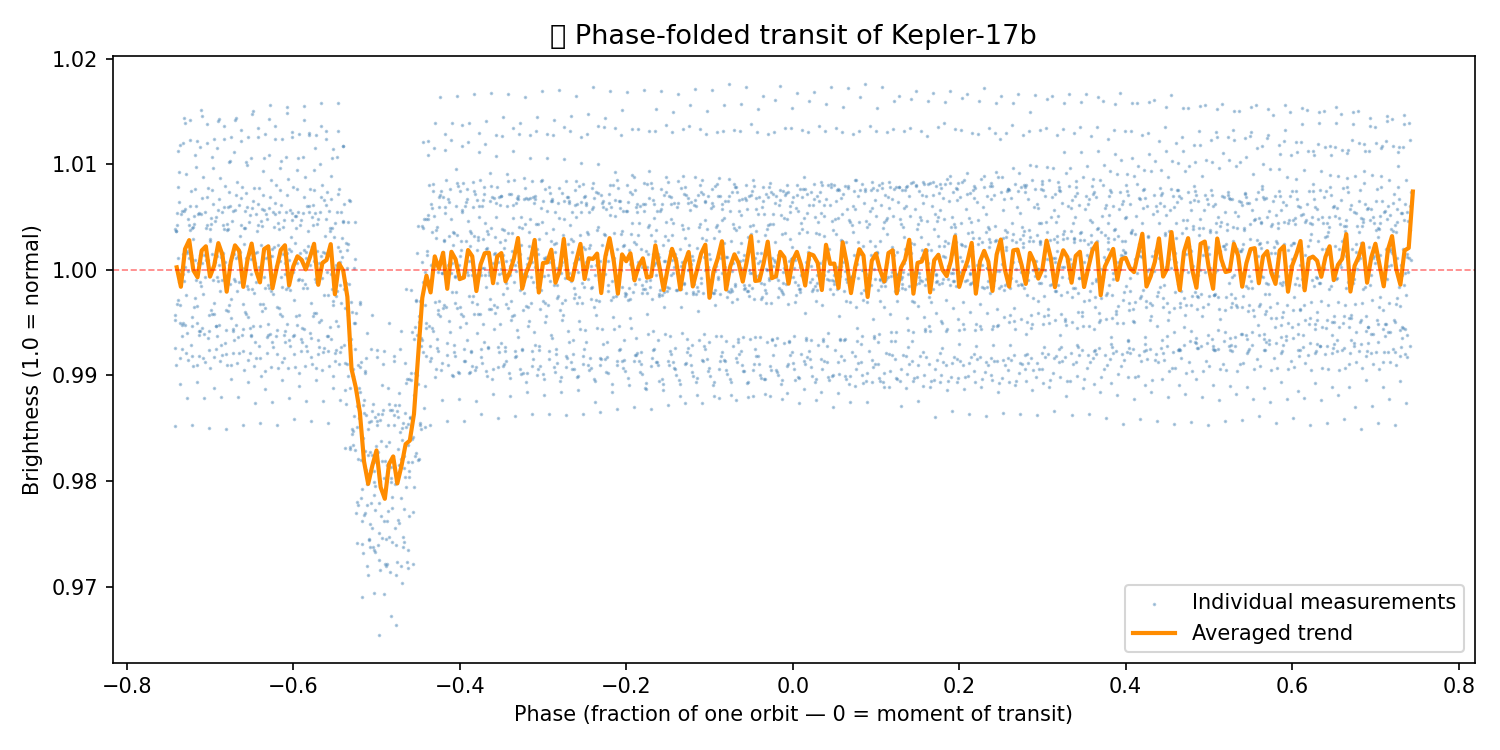
All transits stacked on top of each other using phase folding (orbital period: 1.4857 days). Stacking amplifies the real signal and averages out random noise, making the transit shape unmistakably clear.
Console Output
/opt/hostedtoolcache/Python/3.11.15/x64/lib/python3.11/site-packages/lightkurve/prf/__init__.py:7: UserWarning: Warning: the tpfmodel submodule is not available without oktopus installed, which requires a current version of autograd. See #1452 for details.
  warnings.warn(
/home/runner/work/hamo-tech/hamo-tech/static/scripts/exoplanet_hunter.py:86: UserWarning: Glyph 11088 (\N{WHITE MEDIUM STAR}) missing from font(s) DejaVu Sans.
  plt.tight_layout()
/home/runner/work/hamo-tech/hamo-tech/static/scripts/exoplanet_hunter.py:87: UserWarning: Glyph 11088 (\N{WHITE MEDIUM STAR}) missing from font(s) DejaVu Sans.
  plt.savefig("01_full_light_curve.png", dpi=150)
/opt/hostedtoolcache/Python/3.11.15/x64/lib/python3.11/site-packages/lightkurve/lightcurve.py:1055: LightkurveWarning: `epoch_time` appears to be given in JD, however the light curve time uses BKJD (i.e. JD - 2454833).
  warnings.warn(
/home/runner/work/hamo-tech/hamo-tech/static/scripts/exoplanet_hunter.py:137: UserWarning: Glyph 129680 (\N{RINGED PLANET}) missing from font(s) DejaVu Sans.
  plt.tight_layout()
/home/runner/work/hamo-tech/hamo-tech/static/scripts/exoplanet_hunter.py:138: UserWarning: Glyph 129680 (\N{RINGED PLANET}) missing from font(s) DejaVu Sans.
  plt.savefig("02_folded_transit.png", dpi=150)
🔭 Searching NASA's database for star: KIC 10619192
   Please wait — downloading data from NASA…
✅ Data downloaded!
   We have 4140 brightness measurements.
   That covers about 89.3 days of observations.

📊 Drawing the full light curve…
   Saved as: 01_full_light_curve.png
   Look for regular dips below the red line — those are planetary transits!

🔄 Phase-folding the data to align all transits…
   Saved as: 02_folded_transit.png

==================================================
🔬 RESULTS — What the data tells us:
==================================================
  Dip depth (how much light was blocked): 3.46%
  Planet-to-star radius ratio:            0.1860
  Estimated planet radius:                1.95 x Jupiter's radius

  The actual known radius of Kepler-17b is about 1.31 x Jupiter.
  How close was your calculation? 🎉
==================================================

📝 WHAT TO WRITE IN YOUR PROJECT:

1. Explain what a transit is and draw a diagram
   (planet passes in front of star → blocks some light → brightness dips)

2. Show the full light curve image and point out the dips

3. Show the folded light curve — explain that stacking transits
   makes the signal clearer (less noisy)

4. Show your size calculation — you measured a planet's size
   from a star 2,800 light years away!

5. Mention that this is exactly how NASA's Kepler mission worked,
   and that it found over 2,600 confirmed planets this way.
Want to run this yourself? Download the script — all you need is Python.